How Dutch Companies Are Adopting AWS, Azure & Google Cloud
Explore how Dutch businesses embrace AWS, Azure, and Google Cloud for digital transformation — driving innovation, scalability, and data security in 2025.


The Netherlands has become one of Europe’s most advanced cloud-adoption ecosystems. From Amsterdam’s fintech startups to Rotterdam’s logistics giants, Dutch organizations are leveraging Amazon Web Services (AWS), Microsoft Azure, and Google Cloud Platform (GCP) to power their digital transformation, boost efficiency, and maintain strong data-sovereignty practices.
Let’s explore how Dutch companies are implementing these leading cloud platforms, the key benefits, industry use-cases, and the strategic differences shaping cloud adoption in the Netherlands.
🌍 The Cloud Landscape in the Netherlands
The Dutch digital economy is thriving. According to IDC and Eurostat reports, over 92 % of Dutch enterprises use some form of cloud service — the highest rate in the EU.
Key factors behind this strong adoption:
-
⚙️ Highly developed IT infrastructure — dense fiber-optic networks and major European data-exchange hubs (like AMS-IX).
-
🧠 Tech-savvy workforce — with a high number of IT graduates and English-proficient professionals.
-
🌐 Government support for digital innovation under the “Digital Netherlands” initiative.
-
🏢 Presence of hyperscale data centers from AWS, Microsoft, and Google within Dutch borders — ensuring GDPR-compliant data residency.
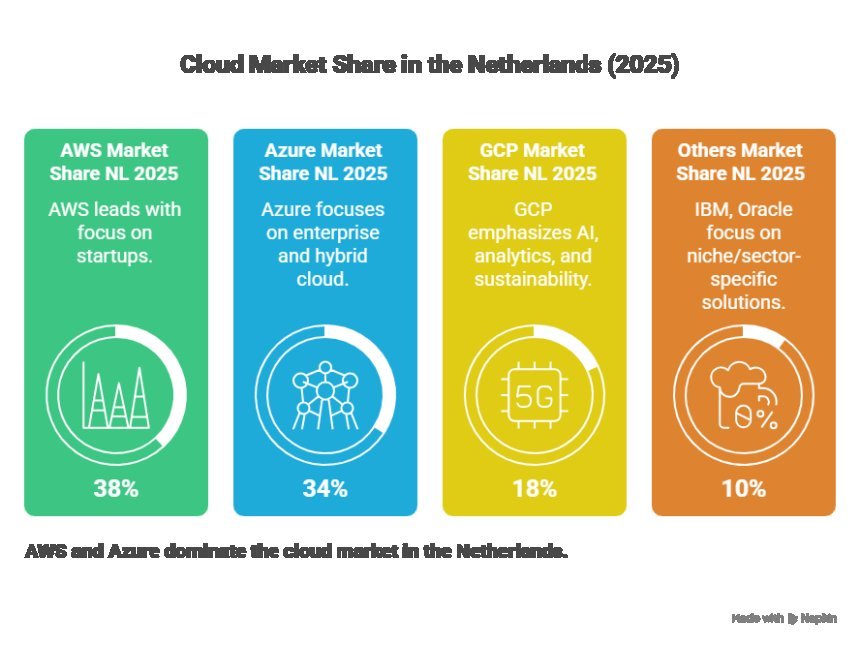
☁️ Cloud Market Share Snapshot (2025)
| Cloud Provider | Market Share NL | Primary Data-Center Region | Focus Area |
|---|---|---|---|
| AWS | ~38 % | AWS Europe (Amsterdam) | Startups, SaaS, IoT |
| Microsoft Azure | ~34 % | Azure West Europe (Netherlands) | Enterprise, hybrid cloud |
| Google Cloud Platform (GCP) | ~18 % | Google Eemshaven Region | AI, analytics, sustainability |
| Others (IBM Cloud, Oracle, etc.) | ~10 % | — | Niche/sector-specific |
(Source: Canalys & Dutch IT Channel, 2025)
🧩 Why Dutch Companies Are Moving to the Cloud
-
Digital Transformation Pressure – The pandemic accelerated the shift to remote work, online services, and AI-driven automation.
-
Scalability & Cost Efficiency – Cloud platforms allow elastic scaling and pay-as-you-go pricing.
-
Data Security & Compliance – Local data centers help meet GDPR and NIS2 compliance.
-
Innovation Enablement – AI/ML, analytics, and IoT frameworks are easier to deploy in the cloud.
-
Sustainability Goals – Dutch firms align with national carbon-neutral initiatives using greener cloud data centers.
☁️ Comparison Table: AWS vs Azure vs Google Cloud in the Netherlands (2025)
| Feature / Factor | Amazon Web Services (AWS) | Microsoft Azure | Google Cloud Platform (GCP) |
|---|---|---|---|
| Market Share (NL) | ~38% | ~34% | ~18% |
| Primary Data Center Region | AWS Europe (Amsterdam) | Azure West Europe (Netherlands) | Google Eemshaven Region |
| Core Focus | Startups, SaaS, IoT | Enterprise, Public Sector, Hybrid Cloud | AI, Analytics, Sustainability |
| Popular Services in NL | EC2, S3, Lambda, Aurora, Cognito | Azure AD, VM, Power BI, AKS, OpenAI Service | BigQuery, Vertex AI, GKE, Looker Studio |
| Target Users | Startups, Fintech, SMEs | Enterprises, Governments, Institutions | AI-driven companies, GreenTech, Research |
| Compliance Strengths | Strong GDPR & ISO certifications | Azure Government Cloud for GDPR/NIS2 | Data residency & carbon tracking tools |
| AI & ML Capabilities | SageMaker, Bedrock | Azure AI & OpenAI Integration | Vertex AI & TensorFlow Ecosystem |
| Sustainability Initiatives | Carbon-offset programs, renewable projects | 100% renewable energy operations by 2025 | 90% renewable energy, carbon-intelligent scheduling |
| Key Dutch Customers | Adyen, Bunq, Bol.com | KLM, Dutch municipalities, Philips | Booking.com, Coolblue, TU Delft |
| Best For | Agile scaling & developer flexibility | Enterprise security & hybrid governance | AI innovation & eco-efficiency |
☁️ 1. AWS Adoption in the Netherlands
📍 Overview
Amazon Web Services has established a strong footprint in the Dutch market, particularly among startups, SaaS providers, and tech-driven SMEs.
AWS’s Amsterdam availability zone delivers low-latency infrastructure and strong data-protection measures.
🔧 Key AWS Services Popular in the Netherlands
-
Amazon EC2 and ECS for scalable compute.
-
AWS Lambda for serverless microservices — widely used by Dutch developers.
-
Amazon RDS and Aurora PostgreSQL for database hosting.
-
AWS Cognito for identity management compliant with GDPR.
-
Amazon S3 for secure cloud storage with versioning and encryption.
🏙️ Example Use Case: Amsterdam Fintech Startups
Companies like Mollie, Adyen, and Bunq rely on AWS for:
-
Real-time transaction processing.
-
Auto-scaling microservices.
-
PCI DSS-compliant architecture.
💡 Benefit: Faster innovation and compliance-ready payment infrastructure.
☁️ 2. Microsoft Azure Adoption in the Netherlands
📍 Overview
Microsoft Azure is the leading choice for enterprise and public-sector organizations. With its West Europe region (Netherlands), Azure offers robust hybrid-cloud capabilities and tight integration with Microsoft 365 and Dynamics 365.
🔧 Key Azure Solutions Used by Dutch Firms
-
Azure Active Directory for identity and SSO.
-
Azure Virtual Machines for scalable workloads.
-
Power BI and Synapse Analytics for business intelligence.
-
Azure Arc and Kubernetes Service (AKS) for hybrid deployments.
-
Azure AI and OpenAI Service for generative-AI use cases.
🏢 Example Use Case: Dutch Government & Public Services
Many municipalities (e.g., Rotterdam and Utrecht) migrated to Azure Government Cloud for:
-
Secure document collaboration.
-
GDPR-compliant citizen-data storage.
-
AI chatbots for public service inquiries.
💡 Benefit: Reliable, compliant digital services for citizens with reduced infrastructure costs.
☁️ 3. Google Cloud Platform (GCP) in the Netherlands
📍 Overview
Google Cloud has expanded rapidly, fueled by its Eemshaven data center — one of Europe’s largest and most sustainable cloud hubs.
It’s especially popular among AI startups, media companies, and sustainability-focused enterprises.
🔧 Key Google Cloud Services
-
BigQuery and Looker Studio for advanced data analytics.
-
Vertex AI for machine-learning workflows.
-
Google Kubernetes Engine (GKE) for container orchestration.
-
Workspace (Formerly G Suite) for productivity.
-
Carbon-intelligent data-centers — powered by 90 % renewable energy.
🌿 Example Use Case: Green Data & AI Innovation
Companies like Coolblue, Booking.com, and Bol.com utilize GCP for:
-
Real-time recommendation engines.
-
Cloud-native analytics.
-
Low-carbon infrastructure.
💡 Benefit: Cutting-edge AI integration with sustainability performance metrics.
⚙️ Multi-Cloud and Hybrid Trends in the Netherlands
Dutch enterprises increasingly embrace multi-cloud or hybrid-cloud strategies — blending AWS, Azure, and GCP.
🔁 Why Multi-Cloud?
-
Avoid vendor lock-in.
-
Match workloads with the best-fit platform.
-
Ensure business continuity and resilience.
🧩 Example Setup
-
Core ERP → Azure.
-
Data Analytics → Google Cloud (BigQuery).
-
App Hosting → AWS (ECS + Lambda).
💡 This interoperability gives Dutch firms flexibility and reduces downtime risk.
🏭 Sector-Wise Cloud Adoption
| Industry | Cloud Usage | Benefits |
|---|---|---|
| Finance & Fintech | AWS, Azure | PCI DSS compliance, scalable payments |
| Healthcare | Azure, GCP | Secure medical data, tele-health |
| Retail & E-Commerce | AWS, GCP | Inventory AI, real-time personalization |
| Manufacturing & Logistics | Azure, AWS | IoT & supply-chain automation |
| Public Sector | Azure | GDPR-compliant document management |
| Education & Research | GCP & AWS | Data analytics & AI for research |
🔐 Data Security & GDPR Compliance
Data sovereignty is a top concern in the Netherlands.
🇪🇺 Dutch Approach
-
All three hyperscalers maintain EU-based regions with GDPR-ready services.
-
Dutch CIOs often employ data-encryption, access control, and zero-trust architecture.
-
Cloud Security Posture Management (CSPM) tools (e.g., AWS Security Hub, Azure Defender, Chronicle Security) are increasingly common.
💡 Regulatory Tip:
The Dutch Data Protection Authority (AP) advises documenting all data-processing activities under Article 30 of the GDPR.
🧠 The AI and Machine-Learning Acceleration
AI adoption in the Netherlands heavily depends on cloud infrastructure.
-
AWS SageMaker helps startups train predictive ML models.
-
Azure OpenAI Service supports enterprise chatbots & co-pilots.
-
Vertex AI enables large-scale model training for research institutions.
Universities, such as TU Delft and Eindhoven University of Technology, collaborate with cloud providers to advance AI ethics and sustainable computing research.
🌱 Sustainability and Green Cloud Computing
The Netherlands aims for climate-neutral data centers by 2030.
-
Google Eemshaven Center uses wind energy and smart cooling.
-
Microsoft West Europe Region runs on renewable sources.
-
AWS Amsterdam Region invests in carbon-offset projects.
Dutch companies align their IT strategies with ESG goals — using cloud monitoring tools to track energy consumption and carbon footprint.
🧭 Challenges in Cloud Adoption
| Challenge | Description | Solution |
|---|---|---|
| Skills Gap | Lack of certified cloud engineers | Invest in AWS/Azure/GCP training programs |
| Compliance Complexity | Navigating GDPR, NIS2 regulations | Partner with certified cloud consultants |
| Cost Management | Uncontrolled spending on resources | Use FinOps tools (e.g., Azure Cost Management, AWS Budgets) |
| Integration Issues | Legacy systems migration | Adopt hybrid connectors & containerization (Kubernetes) |
🚀 Dutch Cloud Success Stories
1. KLM Royal Dutch Airlines – Azure + AI
Uses Azure Machine Learning and IoT Hub for predictive maintenance and fleet analytics.
2. Bol.com – AWS + Microservices
Runs thousands of containers on AWS ECS to power e-commerce recommendations.
3. ING Group – Multi-Cloud Strategy
Combines AWS and Google Cloud for core banking and risk analysis, ensuring data redundancy and resilience.
4. Philips Healthcare – GCP + Healthcare AI
Processes anonymized patient data on GCP for diagnostic AI solutions.
📈 The Future of Cloud Computing in the Netherlands
-
Hybrid Edge Computing – driven by 5G and IoT projects in Rotterdam Port and Eindhoven Tech Campus.
-
Sovereign Cloud Solutions – new EU regulations encouraging “trusted clouds.”
-
AI-as-a-Service Growth – enterprise AI models hosted securely in Netherlands-based data centers.
-
Quantum Cloud Exploration – collaborations between QuTech (TU Delft) and Microsoft Quantum Labs.
💡 Outlook:
By 2028, cloud services are expected to contribute over €45 billion to the Dutch GDP and generate tens of thousands of high-skilled IT jobs.
🧾 Summary
| Cloud Provider | Dutch Adoption Highlights | Key Industries |
|---|---|---|
| AWS | Startups & Fintech dominance | Payments, e-commerce, SaaS |
| Azure | Government & enterprise hybrid | Public sector, manufacturing |
| Google Cloud | AI & sustainability focus | Retail, education, green tech |
| Multi-Cloud | Common strategy for resilience | Cross-industry |
🪶 Conclusion
The Netherlands is fast becoming Europe’s most cloud-driven economy. Whether it’s a startup scaling on AWS, a government agency on Azure, or a research lab innovating with Google Cloud, Dutch organizations demonstrate how technology and trust can coexist.
With a focus on sustainability, GDPR compliance, and AI innovation, the Dutch cloud ecosystem is paving the way for secure, scalable, and future-ready digital transformation.
Share
What's Your Reaction?
 Like
0
Like
0
 Dislike
0
Dislike
0
 Love
0
Love
0
 Funny
0
Funny
0
 Angry
0
Angry
0
 Sad
0
Sad
0
 Wow
0
Wow
0